Routes and trips
 Map
Map MPR - cyclist-friendly places
 POI
POI Plan your trip
 Bike counters
 Publications
 News
News Route concept
 Contact
 Power Plant
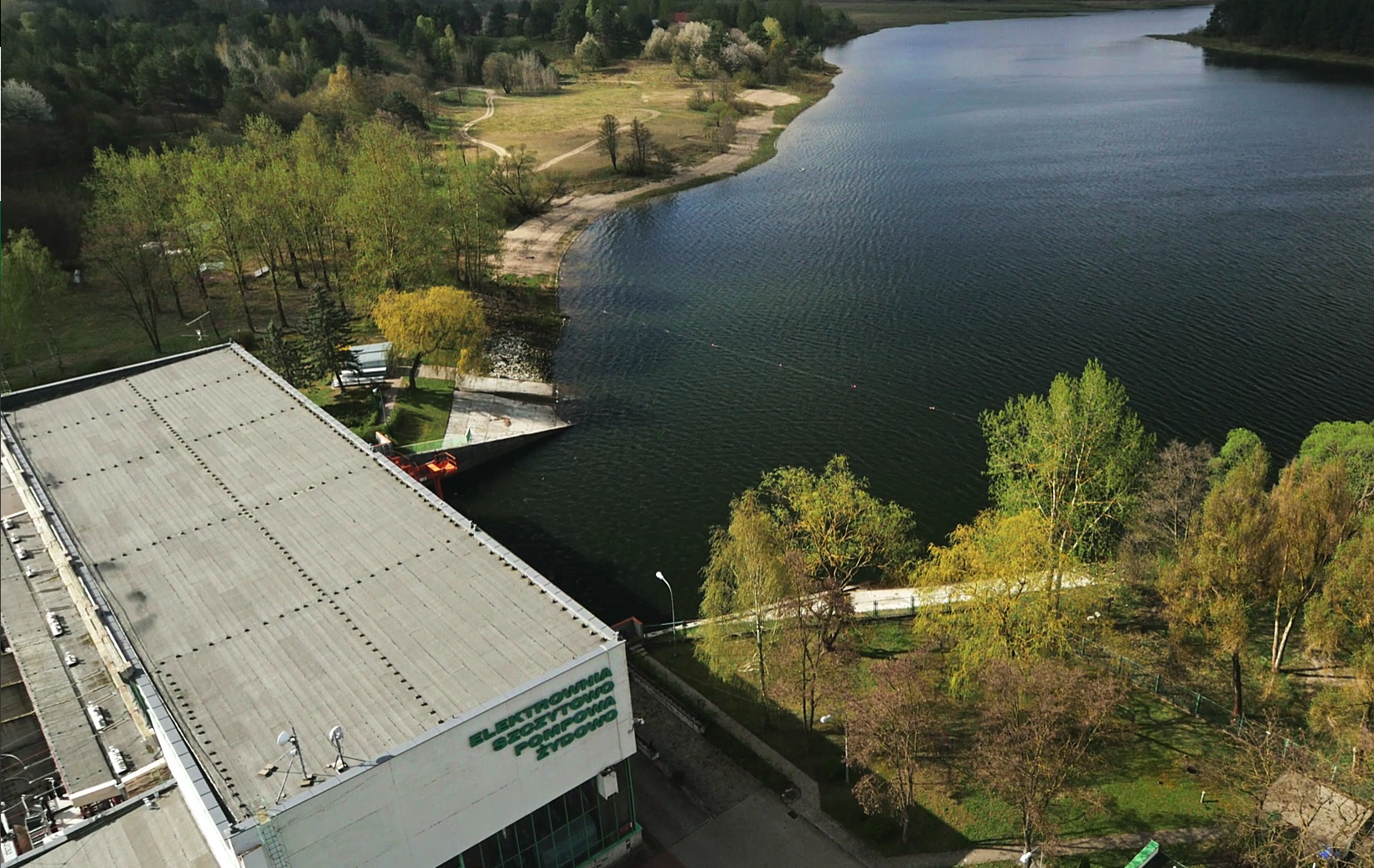
 The Żydowo Power Plant is a pumped-storage power plant located in Żydowo in the Koszalin County, in the West Pomeranian Voivodeship. The first mentions of the potential for harnessing the energy of two natural water reservoirs—Lake Kamienne and Lake Kwiecko, which are located close to each other and have a significant difference in water levels—date back to the 1930s. The initial design proposal called for the construction of a 45-MW pumped-storage power plant equipped with two Francis turbines, each with a capacity of 22.5 MW, and two pumps, each with a capacity of 16 MW. The project was halted by World War II. In the postwar period, the first study was completed in November 1957 as design specifications. Three power plant capacity options were considered: 50, 100, and 150 MW. Option 3 was selected for implementation, and in 1958 work began on the preliminary design, which was completed in December 1960. Work on the technical design of the power plant began in 1961. Construction of the power plant began in 1966 and was completed in 1971. Every second, 240 cubic meters of water are directed onto the turbine blades, enabling the power plant to generate 156 MW of power. During periods of excess energy in the grid at night, two reversible turbine units pump three million cubic meters of water back into the upper reservoir.
The connection between the two lakes provides an ideal topography for the construction of a power plant that would take advantage of the natural features of both bodies of water. It is worth noting that Lake Kamienno (the upper lake) is a landlocked lake of glacial origin. The natural water level in this lake was 160 meters above sea level. Following the construction of the power plant, it fluctuates between 158 m above sea level (which is the minimum operating level) and 162 m above sea level. As the water level changes, other parameters of the lake also change. The surface area at the maximum level is 99 ha, while at the minimum level it is 78 ha. The volume of water contained between the maximum and minimum levels is over 3.5 millionm³. This water is used to generate electricity. When the power plant is operating at full capacity, the water level in the upper reservoir drops at a rate of approximately 90 cm per hour, while when water is pumped upward, it rises by approximately 50 cm per hour. Obviously, such daily fluctuations in water level lead to erosion of the banks despite their artificial reinforcement, and after a certain period of operation, repairs will be necessary.
In contrast, the Radew River flows through the lower Kwiecko Lake, serving as a natural regulator of the water balance between the two lakes and the power plant. A dam with a regulated weir has been constructed at the point where the Radew River flows out of the lake. Closing and opening this weir allows for the maintenance of strictly defined water levels in both lakes. The amount of water in the lakes determines the so-called head—that is, the vertical distance between the water surfaces of the two reservoirs—which in turn affects the amount of power generated by the generators. In winter, due to significant water level fluctuations and the constant mixing of warmer layers, the lakes do not freeze completely. Ice covers only the western part of the lower lake (beyond the island) and the central part of the upper lake.
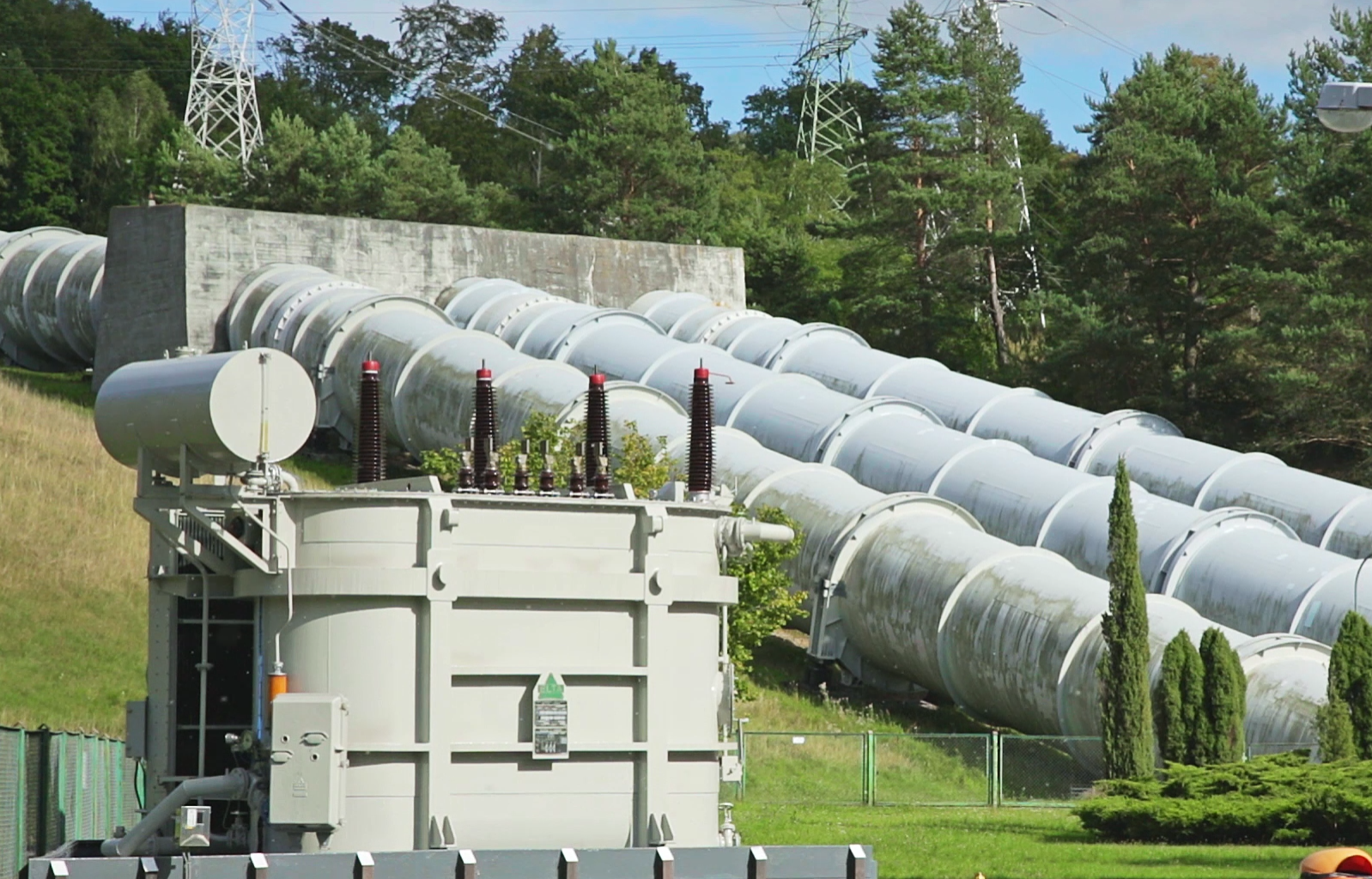
The power plant consists of several components: a 1,300-meter-long diversion channel running from Lake Kamienno. The channel has an inverted trapezoidal cross-section. Its initial section runs through a cut. Beyond the bridge on the Polanów–Bobolice road spanning the canal, the terrain slopes downward and the water flows through an embankment. Before the intake chamber for the pipelines, the canal widens, forming a reservoir that compensates for fluctuations in water level. The intake chamber, in turn, is a complex of equipment connecting the canal to the pipelines. It contains emergency gate valves, designed to cut off the water supply to the turbines in critical situations, as well as maintenance gates used to seal off the pipelines during repairs. Each turbine unit, meanwhile, is connected to the power plant’s upper reservoir via its own 5-meter-diameter feed pipeline (by comparison, the tallest vehicle permitted by regulations to travel on public roads may be up to 4 meters high). As the water flows toward the turbine, it strikes the rotor, which it sets in motion, and in turn drives the generator that produces electricity.
The power plant is open to visitors. In recent years, a parking area was established along Route 205. It is located next to the canal of the pumped-storage power plant in Żydowo. This is a place where both passenger cars and buses can easily park. There are covered benches and tables there.