Routes and trips
 Map
Map MPR - cyclist-friendly places
 POI
POI Plan your trip
 Bike counters
 Publications
 News
News Route concept
 Contact
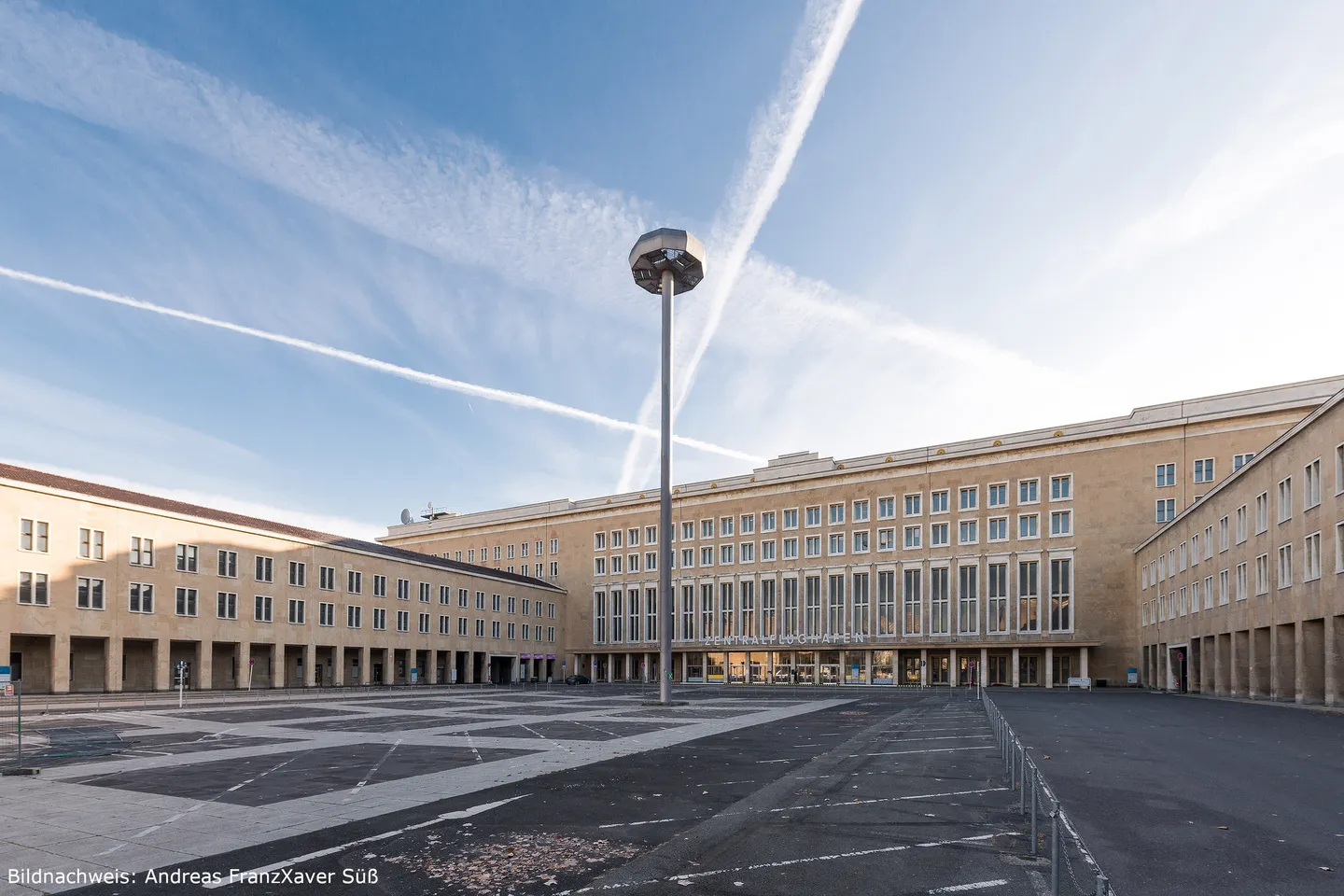
 Tempelhof Airport (Central Airport Berlin)
 Berlin’s First Central Airport – Count Ferdinand von Zeppelin circled the Tempelhof parade ground in 1909 in his airship. In 1923, the location opened as an airfield with a small passenger terminal. By the 1930s, Berlin already had more passengers than Paris or London. In 1936, under the Nazis, construction began on the current airport building designed by Ernst Sagebiel. It has more than 7,000 rooms and is 1,200 meters long, making the bow-shaped hangar as large as a small town. The building was never finished. In 1939, arms manufacturers moved in. Forced laborers housed in a barrack on the field assembled military equipment. Air traffic continued to go through the 1923 terminal. After WWII, the Americans used Tempelhof as a military airfield but also opened parts of it to civil aviation. The Airlift made the airport a world-famous symbol of freedom. It was closed to air traffic in 2008. Europe’s largest landmarked building is now home to major events and is also used by the Berlin Police and as a control center for the city’s traffic. In the future, an arts and culture center will open there, with a 1.2-kilometer History Gallery on the roof. Starting in spring 2023, visitors will be able to go onto the roof of the western main building, where the air traffic control tower is located, and enjoy the breathtaking view of the city.
TIP: CHECK-IN Visitor Center: exhibition on “Tempelhof Airport and Its History” | starting point for tours of the building check-in.thf-berlin.de/en