Routes and trips
 Map
Map MPR - cyclist-friendly places
 POI
POI Plan your trip
 Bike counters
 Publications
 News
News Route concept
 Contact
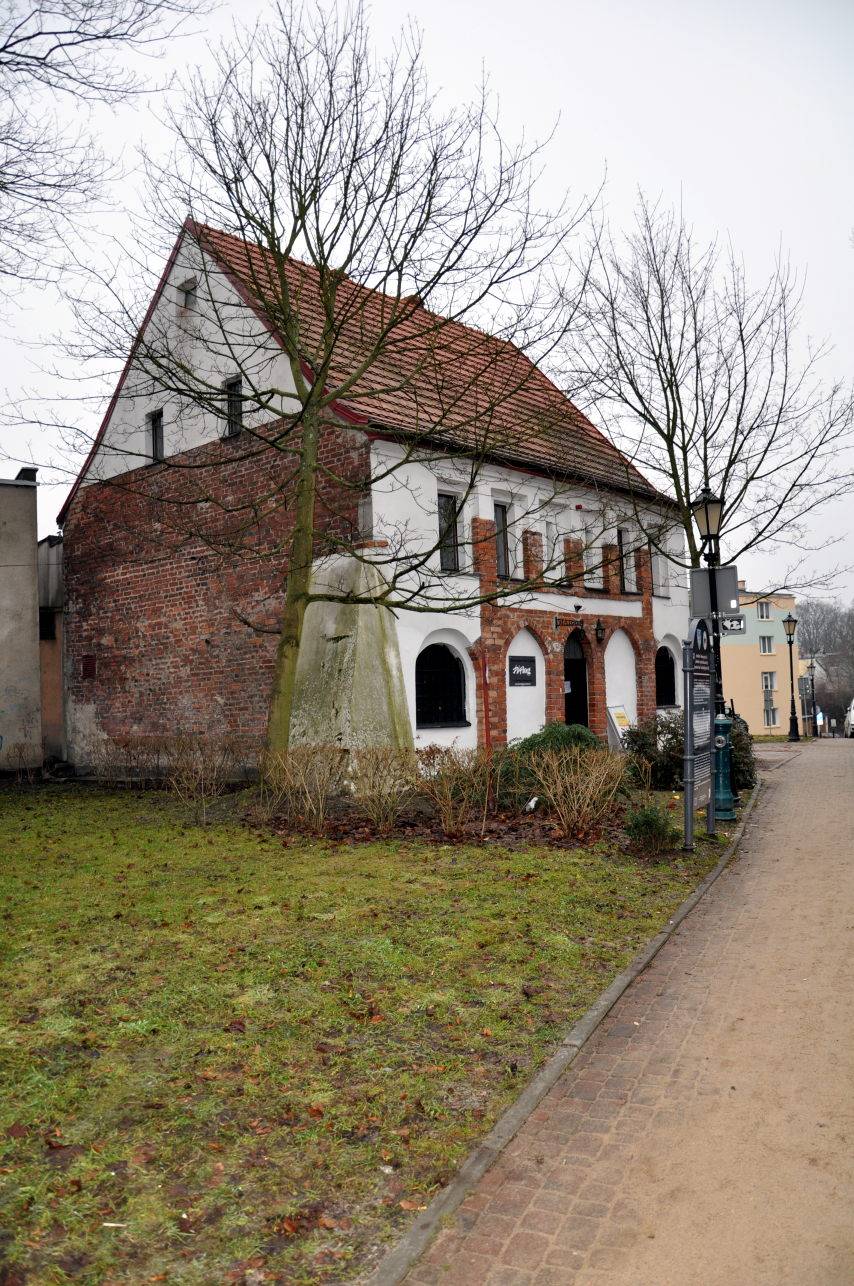
 Cultural Center 105 - The Executioner's Cottage in Koszalin
 Kata’s House at 3 Grodzka Street is a Gothic townhouse built in the 15th century on a trapezoidal plan, a design dictated by the curved course of the city walls at this location, likely incorporating a section of an earlier tower. The preserved front facade, revealed beneath the plaster, captivates with its Gothic architecture—a pointed-arch entrance and blind windows on the ground floor, a corner buttress, and wall pilasters reaching halfway up the first floor. It currently serves as the headquarters of an association called the “Dialog” Theater of Proposals, which specializes in contemporary one-actor plays. It is also a venue for recitation performances and other cultural events. In the past, this tenement house was home to the executioner, who had been employed full-time since 1464, when the city council purchased from the bishop the right to hold trials and issue sentences. At that time, minor offenses were punishable by flogging, the pillory, or being placed in stocks. Serious crimes were punished by death, carried out in various ways. Parricides were stuffed into a sack and drowned; witches were burned at the stake; and those guilty of other crimes were hanged or beheaded. Depending on the convict’s social status, executions took place in one of two locations: on Hangmen’s Hill on Dąbrowskiego Street (behind the open-air museum), where the gallows stood, or, on an ad hoc basis, in the Old Town Market Square—exclusively for those of noble birth. The profession of executioner remained within the family and was passed down from father to son. The executioner carried out his last sentence in 1893, but his family continued to live in this tenement house well into the interwar period. In the Middle Ages, the execution of sentences was also a spectacle for the crowd, and the executioner received fair compensation for his services. According to a sort of price list for executioner’s services, the most money could be earned by beheading or burning a convict—as much as 10 florins. Half of this amount was
allocated for torture, including breaking on the wheel, and for burying a suicide victim (superstition forbade others from touching the corpse). Simply placing someone in the pillory, flogging, or shackling them in the stocks cost the city treasury only 9 shillings. Women guilty of slander faced a peculiar punishment. They had to stand outside the church for the entire service carrying a heavy sack of stones; reportedly, this was a fairly effective remedy for gossip.




You will not get lost on the route with us! In our application you will find a detailed map of routes and excursions, interesting places and events, 360 panoramas and much, much more!