Routes and trips
 Map
Map MPR - cyclist-friendly places
 POI
POI Plan your trip
 Bike counters
 Publications
 News
News Route concept
 Contact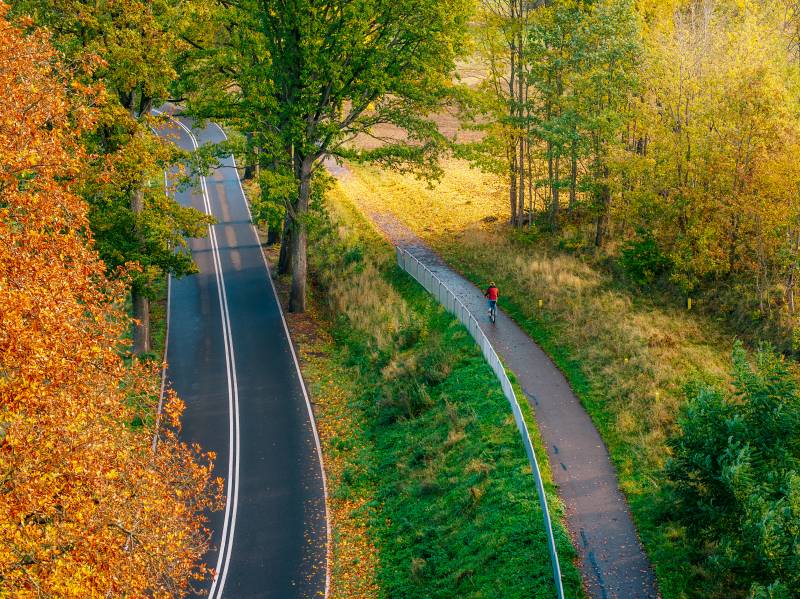
For several years now, Western Pomerania has been among the most popular regions in Poland for tourists. This is confirmed by a Eurostat report containing data for 2024, as well as more recent statistics published by the Central Statistical Office (GUS). In 2024, accommodation establishments in the West Pomeranian Voivodeship, which has a population of 1.6 million, recorded 16.5 million overnight stays – a national record. Last year’s figures are equally impressive, as are the figures for the first half of this year.
Not just the Baltic Sea
– Tourism is booming; it’s a massive industry. What matters most is the number of overnight stays. In Western Pomerania, we already have over 17 million per year, and we are by far the most hospitable region. That accounts for 20 per cent of all overnight stays in Poland. We are followed by Lesser Poland, which has the mountains, Podhale and Kraków, and Mazovia with its much-visited Warsaw,” says Olgierd Geblewicz, Marshal of the West Pomeranian Voivodeship.
However, he notes that the provincial government is making efforts to ensure that Western Pomerania is not associated solely with the Baltic Sea. “Other parts of the region, with a wealth of accommodation options or a well-developed network of cycle routes, are also attracting more and more tourists, not just during the summer holidays,” he adds.
Multi-day exploration
Over the past decade, nearly a thousand kilometres of cycle routes have been built in West Pomerania. These routes allow cyclists to reach many places across the province. The main idea was to create a coherent network of cycle paths enabling tourists to explore the region over several days. For the time being, five main routes are largely complete:
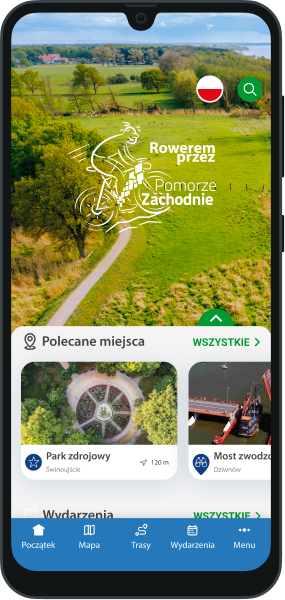
Velo Baltica (along the Baltic coast), the Western Lake District Route (crossing the region from the border crossing at the bridge in Siekierki to the vicinity of Szczecinek; it also has a link to Szczecin), Blue Velo (connecting the Baltic Sea, the Szczecin Lagoon and the Myślibórz Lake District), the Old Railway Trail (linking the Baltic Sea waterfront in Kołobrzeg with the south of the province in the Wałcz Lake District) and Around the Szczecin Lagoon. Detailed route maps and up-to-date information on roadworks or disruptions can be found in the ‘Pomorze Zachodnie’ mobile app. It’s a brilliant tool that will help you plan your trip, but it also ensures you won’t miss the many attractions waiting along the way: historic sites, parks and points of interest such as the concrete structure or the suspension bridge over Lake Raduńskie.
Are we facing overtourism?
There has been significant interest in this initiative for years. The figures speak for themselves. There are 24 sensors in Western Pomerania designed to count cyclists. In 2024, these devices recorded 1,763,115 journeys, and in 2025 a comparable figure: 1,680,514. Meanwhile, during the 2026 summer holidays, nearly a million journeys were recorded. There’s also a new single-day record!
On 16 August, our counters recorded as many as 23,535 journeys. If we compare this information with the data from the Central Statistical Office (GUS) mentioned at the start of this article, it is sure to be welcome news for all those who make their living from tourism. This is also a boost for the region’s economy, but as Hubert Gonera, a tourism industry expert, warns, residents of the region – particularly those in coastal towns, which attract the most visitors – may soon experience ‘overtourism’, or tourist overload. This phenomenon, in which the number of tourists in a given location exceeds its capacity for sustainable operation, results in infrastructure overload, environmental degradation and a decline in residents’ quality of life. How can this be prevented?
Off the beaten track
Here, Gonera presented the concept of regenerative tourism – that is, tourism designed to bring about positive changes for both the environment and the local community, its culture, traditions and so on. This is the case, for example, in the Faroe Islands, where tourists can book a course in knitting woollen garments. In this way, traditional local crafts are kept alive. Other examples of this type of tourism include kayaking trips during which participants clean up the river. It also involves visiting lesser-known and less-frequented locations in the region. This is highlighted by Wanda Nowotarska, the Marshal’s representative for cycling communications, who leads the team developing a network of cycle routes in West Pomerania.
“Cycling tourists appreciate less-frequented places; they are keen to visit off-the-beaten-track locations that are nonetheless very interesting. Such places are difficult to reach without a bike, as most cycle routes are created away from the main roads, closer to nature,” she explains.
That is why the provincial authorities are encouraging people not only to visit the most popular cycle route, Velo Baltica – which runs along the Baltic coast – but also to explore exceptionally picturesque areas, such as those in the south of the region, or the Western Lake District Route, which heads eastwards.
What lies ahead?
Western Pomerania is keeping up the pace and is carrying out further sections to complement the existing infrastructure. A nearly 9.3-kilometre section between Stepnica and Kopice is currently under construction; it will run along the flood defences bordering the Szczecin Lagoon. By the end of November this year, the Góralice–Dobropole road – which forms part of the Western Lake District Route and features a dedicated cycle lane – is due to be refurbished. Meanwhile, by October 2027, a section of nearly 2 kilometres will be completed, linking the existing Trzebiatów–Roby cycle path with the Velo Baltica (EV10/13) coastal route; in the longer term, this forms part of the Rega and Drawa Valley route, which in a few years’ time will connect Gryfice with Mrzeżyno. Also as part of the reconstruction of the DW 102 between Trzebiatów and Zieleniewo (near Kołobrzeg), over 20 km of cycle paths are being built. Work on the sections in the municipalities of Marianowo, Dobrzany and Ińsko is due to be completed this autumn.
Key section
The section between Golczewo and Upadły is also due to be completed this autumn, and further sections of Route 800 are planned: Stepnica–Babigoszcz, Kłodzino–Golczewo and Upadły–Świeszewo. By 2029, a completely new section of the route between Stepnica and Ryman, over 82 km long, will be built. Closing this gap in the West Pomeranian cycle route network, which already spans hundreds of kilometres, will create an 800-km loop connecting Szczecin, Kołobrzeg and the German capital.
– Today, it is quite safe to cycle from Berlin to Kołobrzeg, but you have to do so via the bridge at Siekierki as part of the Lake District Route. We want it to be possible to do this from the north, discovering the magnificent areas of the Goleniów Forest, the Golczewo region and the Gryfice region. It will certainly be a very charming route,” says Olgierd Geblewicz, Marshal of the West Pomeranian Voivodeship.
This article is co-financed by the European Union under the project entitled ‘Berlin–Szczecin–Kołobrzeg Cycle Route’, implemented as part of the Interreg VIA Mecklenburg-Vorpommern/Brandenburg/Poland Cooperation Programme 2021–2027.