Routes and trips
 Map
 MPR - cyclist-friendly places
 POI
 Plan your trip
 Bike counters
 Publications
 News
 Route concept
 Contact
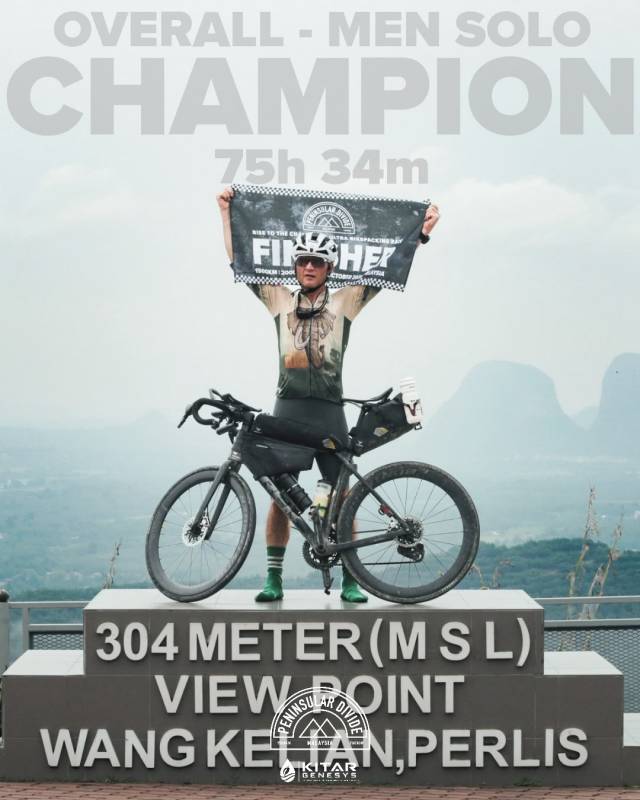
We’re speaking shortly after your return from Asia, where you took part in the 2026 Peninsular Divide race in Malaysia. What’s more, you won it and set a new record. What sort of race is it?
It’s a route covering over 1,500 km, running across the Malay Peninsula, from Pengerang in the south, near Singapore, all the way to Wang Kelian in the north, on the border with Thailand. Among other things, it crosses the Banjaran Titiwangsa mountain range. You ride on tarmac sections and gravel tracks, but also through difficult jungle terrain, where I sometimes had to carry my bike because the path was impassable. It’s currently summer there, and as the country is situated close to the equator, it’s very humid; and when it rains, you can’t see what’s two metres in front of you. The first challenge was simply getting my bike into Malaysia. It was a self-supported race, so I was on my own. I had to carry all my spare parts, water bottles and food with me and manage them carefully.
You broke the route record, completing it in 75 hours and 34 minutes.
I cycled for three days and nights without sleep, and beat the course record by six hours. I wouldn’t have done it if it hadn’t been for my rival, who was really pushing me hard. He also achieved a very good time, finishing just two hours after me. We even met at the final checkpoint, where I was having trouble with my feet. Over the whole route, I took a total of six hours’ break.
You only became seriously interested in cycling after you turned 40. How did you get into ultra-cycling?
Sport has always been a part of my life. I used to play football with my mates up to five times a week. As for cycling, though, I didn’t want to give it a go because I thought I’d be rubbish at it. The turning point for me was a ride on a bike I borrowed from a neighbour. I cycled from Mierzyn to Uckermünde and back. I really enjoyed it. Later, I took part in an ultra-marathon around the Szczecin Lagoon; although registration had actually closed, I still managed to sign up. Then came further events in Poland, such as ‘Piękny Wschód’, and in 2022 I took part in ‘Race Around Poland’, which I won in the solo semi-supported category. Finishing that race qualified me for the “Race Across America”. I took part in that too, but organising all the logistics and the team required a lot of work. There, I came second in the overall classification, but I was the fastest in the under-50s category.
You make it sound as if it all comes effortlessly. How do you prepare?
It might sound strange, but I do a lot of things on the spur of the moment. I don’t use heart rate monitors, power meters, cadence sensors, special diets, and so on. Of course, I have to train, because you need to be in shape – without that, you won’t get anywhere. The most important thing is your head; that’s what makes your legs move. When I was riding the ‘Race Across America’, at the start it seemed to me that the race would be dominated by riders aged 20 or 25, including professionals from Portugal or Germany with large teams and top-notch kit. It turned out that at the finish line, I was the youngest of the top four riders, and I was 48. Of course, fitness, natural ability and preparation are important, but the mental aspect is crucial. In ultra races, you can’t ‘burn yourself out’; you have to manage your sleep and food well. Ultra races are won at the rest stops. During the race in Malaysia, my rival probably had a better time than me on some sections, but perhaps I managed the crises – which are an integral part of this discipline – better.
Is ultra-cycling a highly professionalised discipline, or a sport for enthusiasts? You take part in races whilst balancing them with your professional life.
Professional cycling is only for a certain group of people. In contrast, virtually anyone can take part in an ultra-ride. I completed my ride to Malaysia in three days, but I’ve just received a message from another participant who only finished the route after three weeks. Some do it just for the ride itself, for the adventure. Ryszard Szurkowski said that all he remembers from races is the front wheel. Here, if you’re in awe of the world – and I am – it’s the perfect sport. I’m really happy with what I do. When I finish one race, I start thinking about which one I could do next. It’s obviously a major logistical and financial challenge, which is why I have to be a bit of a marketer. But it’s worth it, because if I can later say that I’ve made ten trips to different parts of the world in the space of a year, I’m actually a bit envious of myself. Of course, I have to balance this with my family and professional life.
What’s it like cycling in Western Pomerania?
I’m proud to live here and I often say that this is the best region to become an ultra-cyclist. We have loads of cycle paths and new sections are constantly being built. A big advantage is that we’re on the border and our paths connect with those on the German side. Even today, we can cycle from Szczecin to Berlin, or around the Szczecin Lagoon, without any major obstacles. My dream is to invite the world’s best riders and show them our routes.
Interviewed by: Szymon Wasilewski
This article is co-funded by the European Union under the project entitled ‘Berlin–Szczecin–Kołobrzeg Cycle Route’, implemented as part of the Interreg VI A Mecklenburg-Vorpommern/Brandenburg/Poland Cooperation Programme 2021–2027.