Routes and trips
 Map
Map MPR - cyclist-friendly places
 POI
POI Plan your trip
 Bike counters
 Publications
 News
News Route concept
 Contact
 Western Lake Districts Route - Stage IV [Ińsko- Złocieniec]
 Stage IV: Ińsko – Drawsko Pomorskie – Złocieniec [44 km]
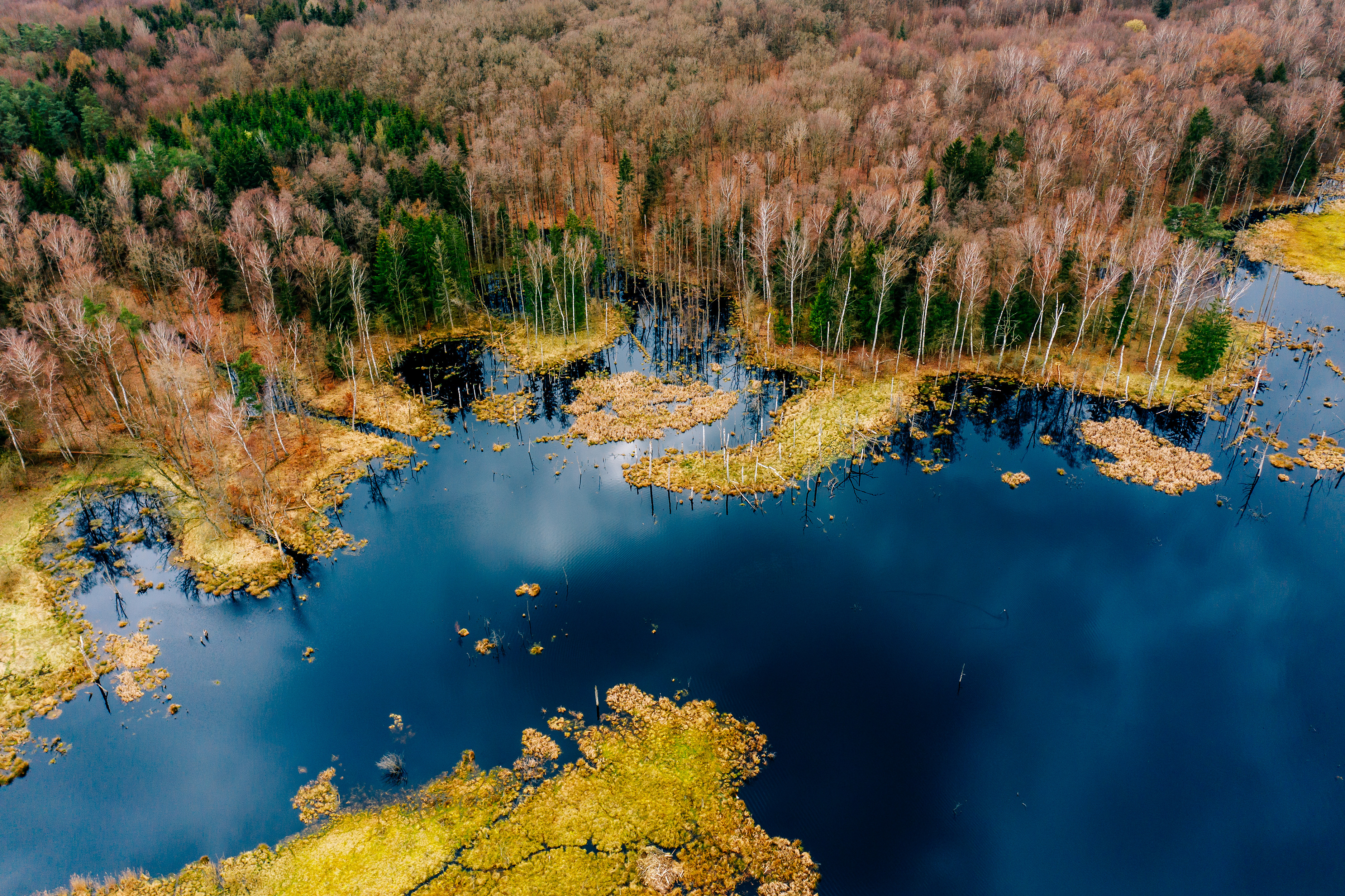
From Ińsko, we take a bicycle path, and then local roads that turn into a difficult-to-pass dirt road between Brzeźniak and Kumki. It is an exceptionally attractive landscape, slightly undulating, with frequent openings onto fields and meadows between dense forest complexes. There are few buildings here, and those that are there are sometimes abandoned. Enthusiasts of exploring such places should take a detour to Brzeźnica, a deserted village with an abandoned but well-preserved church from the 17th/18th century. Taking this detour, you will also see an impressive granary from the early 20th century, designed by the world-famous architect Walter Gropius. It is the only building preserved from the entire complex of farm buildings in Jankowo.
Drawsko Pomorskie is famous primarily for its Land Forces Training Center, better known as the largest military training ground in Europe. It is located southwest of the city and covers an area of 40,000 hectares, occupying ⅓ of the municipality. Armies from all NATO countries train here, and the camps on its territory can accommodate 3,000 soldiers at a time. However, Drawsko does not live by the army alone. PARK - the Drawsko Street Theatre Festival is one of the biggest theatrical events in the region. Over the course of one summer weekend, several outdoor performances take place in Chopin Park. There is also no shortage of historical monuments, such as the Gothic Church of the Resurrection, the Mentzler Villa (also designed by the aforementioned architect Walter Gropius) and the restored salt warehouse, which now houses a regional museum.
The town and the training ground are, of course, named after the Drawa River, undoubtedly one of the most beautiful rivers in Poland. A canoeing trail named after Cardinal Karol Wojtyła, who canoed down it several times in his youth, stopping to rest in Drawsko Pomorskie, has been marked out on the river. Our next stop, Złocieniec, is also located on the river. If you were to go in the opposite direction and show a great deal of determination, you could load your bike onto a canoe and paddle this section, thus practicing bikerafting. However, this would be difficult due to fallen trees. It is much easier to simply hand over your bike to the company that transports the kayaks. We highly recommend this way of diversifying your trip!
In Złocieniec, you can take a break in Żubr Park, which, although it has nothing to do with the king of Polish forests, offers a monumental Hornbeam Avenue, which forms a tunnel of intertwined tree branches, known as a bindaż. There are 83 hornbeams growing here, estimated to be around 200 years old. An interesting fact from a completely different angle is... a dragon. It turns out that Krakow is not the only place with a fire-breathing dragon. The one in Złocieniec is even better because it can flap its wings. You can see Jędrzej's dragon on private property, in front of the house at 40 Śląska Street. We recommend visiting Złocieniec in the spring, when the "16 Południk" travel festival takes place here, where many kindred cycling souls meet.
The sections between Ińsko and Wiewiecko and between Drawsko and Zarańsko have been marked and opened to traffic. The section between Wiewiecko and Drawsko will be completed at a later date, but only a fragment of it is difficult to pass (the forest dirt roads between Brzeźniak and Kumki). We recommend taking a detour along asphalt roads through the Drawsko Military Training Area - after Storkowo, head towards Studnica, Ziemsko, and Oleszno.
Transport: PKP railway stations are located in Złocieniec, Drawsko Pomorskie, and Wiewiecko (on the Szczecin-Szczecinek line) and near the route in Chociwel ( on the Szczecin-Koszalin line). Connections are operated by POLREGIO. The timetable can be found at https://portalpasazera.pl
Surface: asphalt 74%, aggregate 19%, dirt roads 7%.
Type of traffic: bicycle paths 35%, general traffic 41%, forest/field roads 24%.